Our Story
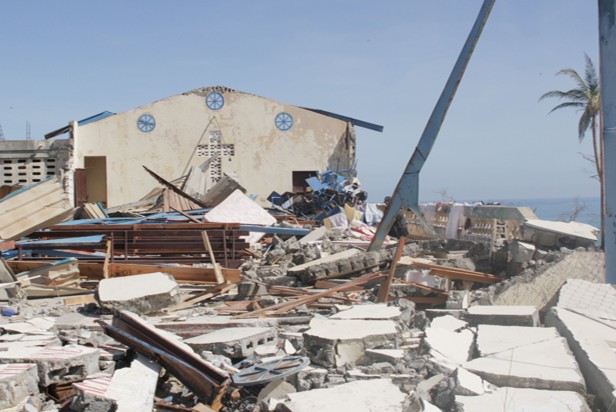
Our journey began in 2016 while witnessing the aftermath of natural disasters, where collapsed buildings left communities rebuilding with temporary shelters such as tents and huts. At the same time, vast quantities of demolished concrete laid unused — an abundant, overlooked raw material capable of rebuilding stronger, more permanent structures.
This realization led us to examine construction and demolition waste more closely. We discovered that these activities account for approximately 25–40% of total solid waste globally (even up over 60% in larger cities), with concrete representing the largest share — often 50–70%, depending on location and year.
What was widely considered waste was, in fact, one of the most underutilized resources in the built environment.
It became clear that focusing solely on disaster response — or on replacing cement, as many companies were attempting at the time — would not be enough. The real opportunity laid in redesigning the system: developing a fully circular solution that utilizes demolished concrete in everyday construction.
With extensive experience in construction and ESG, our objective was clear from the outset: create a solution that meets the performance, cost, and usability standards of conventional concrete — without requiring new production investments.
The material had to deliver higher strength, improved cost efficiency, operational simplicity, and significantly lower direct and indirect CO₂ emissions.
We made a bold decision: not only to replace virgin aggregates
in concrete production, but to improve them.
Through research, testing, and pilot projects, we encountered and solved the widely recognized chemical and mechanical challenges. This led to a critical insight: the challenge was not merely material substitution — it was value chain control.
Replacing virgin aggregates was insufficient.
The entire recycled concrete value chain had to be managed and optimized.
We turned that challenge into opportunity.
Our solution ensures full quality control of recycled concrete aggregates (RCA), reliable access to raw materials, and optimized mix design tailored to application-specific requirements.
After extensive research, experimentation, and piloting, we demonstrated that virgin aggregates can be replaced with RCA while meeting performance, cost, usability, and CO₂ reduction targets — without requiring new production equipment.
What began as an effort to support disaster-affected regions evolved into a scalable, integrated solution capable of transforming the global concrete value chain.
Join us in transforming waste into value.
Our Milestones
Research into demolished concrete and recycled concrete aggregates (RCA) begins.
Research confirms the feasibility of using RCA to replace virgin aggregates.
Development of a new methodology for integrating RCA into construction projects.
First pilot projects completed with selected customers.
Initial funding secured to advance RCA application research.
RCA successfully implemented across multiple applications, from structural elements to retaining walls.
Team expanded to support international market access.
First patents filed.
Several add-on innovations discovered and being further researched.
Global customer and partner discussions initiated to assess market-specific requirements.
Additional patents filed.
Development of value chain control solutions initiated; additional funding secured to support continued growth.
Pilot projects confirmed in the United States.